- Call Us :+86 13663796880
- Email :nicole@sfrooftile.com
- Working hours :24 hours a day
- Language :Chinese

Nicole Zhang
+86 13663796880
+86-379-63262958
nicole@sfrooftile.com
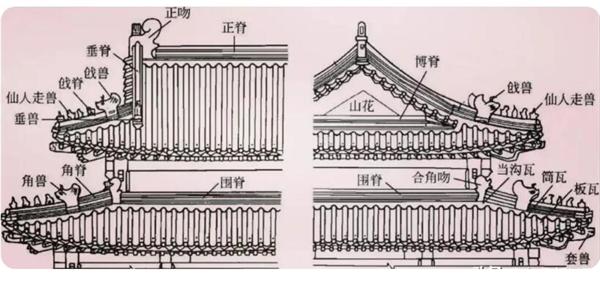
When looking up at a traditional Chinese Xieshan (hip-and-gable) or Wudian (hipped) roof, the raised lines formed by the intersection of roof slopes are known as ridges. The central line is the main ridge; those sloping downwards in four directions are the descending ridges; and those branching off at the corners are the branching ridges (or 戗脊). The roof's silhouette is defined by the termination points of these ridge lines.
The ridge serves as the finishing point for the tiling work. Where roof tiles meet, a ridge is essential to prevent rainwater from seeping into the gaps. Constructed by layering ridge tiles and securing them with cement mortar, the ridge simultaneously seals the seam and creates a distinct line—a perfect fusion of function and aesthetics.
Descending ridges slope down from both ends of the main ridge, transitioning into branching ridges at the upturned eaves (wing corners). At this corner, the ridge splits, marking a shift in structural direction and the most elaborate point of ornamentation.
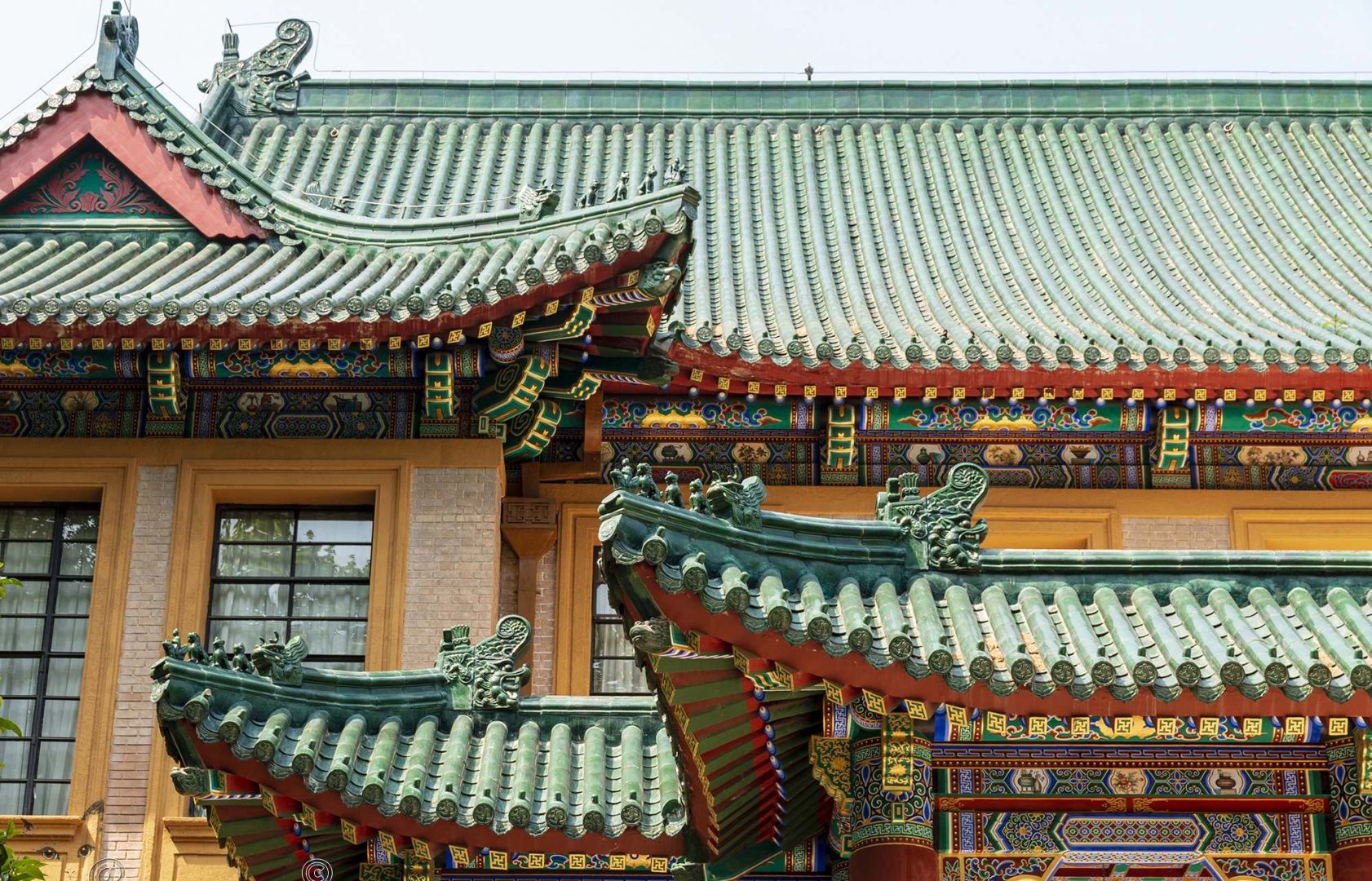
A beast sits at the lower end of the descending ridge—known as the "descending ridge beast"—with its mouth "swallowing" the ridge and its tail pointing skyward. Ridge Beasts are primarily architectural and decorative elements, while the underlying ridge construction and fixing system provide the necessary mechanical support and weather protection.
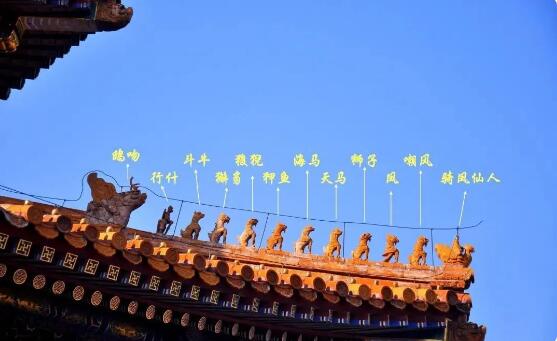
A procession of "walking beasts" lines the front section of the branching ridge. Leading the way is an immortal riding a rooster, followed by creatures such as the dragon, phoenix, lion, seahorse, and heavenly horse. Their number is determined by the building's rank and is typically odd. Originally serving as decorative caps for the iron nails securing the ridge tiles, they evolved into a formal procession of auspicious beasts.
The branching ridge beast sits midway along the branching ridge, echoing the descending ridge beast; together, they guard the two ridges meeting at the corner. With one beast anchoring the descending ridge and the other the branching ridge, the structural junction of the roof corner is quietly stabilized by these two small figures.
The number of roaming beasts is strictly regulated: three, five, seven, nine, or a maximum of ten (including the Hangshi figure). The Hall of Supreme Harmony in the Forbidden City features the full set of ten, signifying the highest rank, while the number decreases for ordinary buildings. The arrangement at the ridge ends directly indicates the status and hierarchy of the hall.
These roaming beasts originated as nail caps. Ridge tiles were secured with iron chains and wooden pegs; as the nail heads were prone to rusting, beast-shaped caps were added to protect them from rain—a practice that eventually became a standard convention. The transformation of a utilitarian object into a ceremonial ornament is a common narrative in the history of Chinese tiling craftsmanship. The style of the roof ridge varies with the roof type itself. A hip roof (wudian) features four sloping ridges, while a gable-and-hip roof (Xieshan) boasts nine; the number of ridges differs, and the arrangement of the zoomorphic figures—the "roof beasts"—follows suit. It is a shared architectural vocabulary used to compose distinct "sentences" across different roof forms.
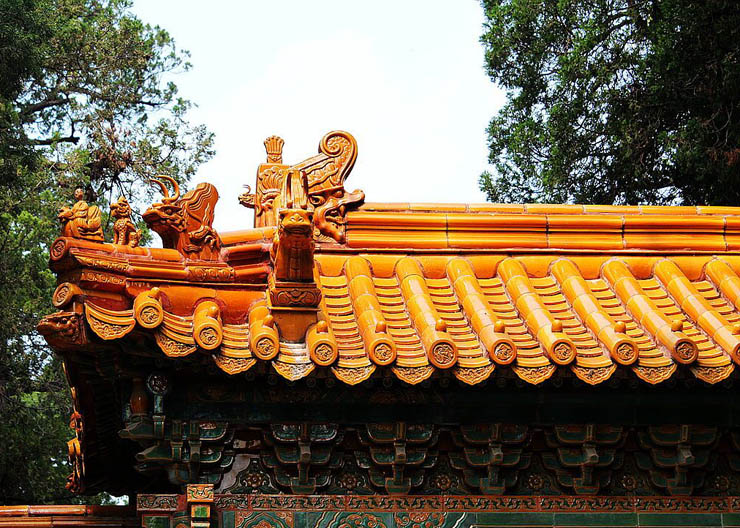
The large "Chiwen" (a traditional dragon-like ridge ornament) at both ends of the main ridge correspond to the Chuishou (Descending Ridge Beasts); with mouths "swallowing" the ridge and dragon tails adorning their backs, they serve as the most prominent protective ornaments on the roof. Together, the main ridge ornaments and the smaller zoomorphic figures—acting as principal and subordinate elements—define the entire ridge line.
On glazed-tile buildings, these ornaments are brilliantly colorful, whereas on vernacular dwellings, they are made of simple, unglazed pottery; this contrast in material reflects the hierarchy of the building itself. A single ridge line thus clearly articulates the social order.
Inspections of ancient roofs often begin with the ridge: if a zoomorphic figure is missing or a Chuishou comes loose, water can be diverted into the structural beams. The integrity of the ridge serves as a vital indicator of the roof's overall health.
Even today, replica ancient-style buildings feature these zoomorphic figures because they are both aesthetically pleasing and functional. When a row of small beasts perches on the upturned eaves, gazing into the distance, it embodies the traditional craft of transforming structural joints into scenic elements.
In restoration and traditional-style construction, ridge components need to be considered together with the roof tile profile, roof pitch, supporting structure, and installation method. A visually correct ridge ornament alone does not guarantee a suitable roof system. Matching the ridge tiles, eaves components, and decorative elements to the overall roof design is important for both appearance and installation.
The Chuishou (descending ridge) and Qiangshou (branching ridges) never clamor for attention, yet they articulate the roof's edges with striking eloquence. From the downward-facing beasts to the smaller roof guard beast figures, the exquisite nature of ancient Chinese architecture often resides in these small components—elements that, inch by inch, channel the flow of wind and rain while assigning roles to the stories told by the building.