- Call Us :+86 13663796880
- Email :nicole@sfrooftile.com
- Working hours :24 hours a day
- Language :Chinese

Nicole Zhang
+86 13663796880
+86-379-63262958
nicole@sfrooftile.com
In the vast majority of casual construction and DIY conversations, concrete breeze blocks and cement breeze blocks refer to the exact same thing: patterned, decorative screen blocks used to build ventilated walls, garden borders, and architectural features.
Because people frequently use the words "cement" and "concrete" interchangeably, the distinction is usually just a matter of regional terminology or supplier naming habits. However, if you look at the technical and material level, there is a minor difference in how they are mixed and finished.
The difference boils down to a classic construction rule: cement is an ingredient, while concrete is the final mixture.
1. Cement Breeze Blocks
2. Concrete Breeze Blocks
| Feature | Cement Breeze Block | Concrete Breeze Block |
| Primary Composition | Cement, water, and fine sand | Cement, water, sand, and lightweight aggregate (like cinders/ash) |
| Surface Texture | Smooth, uniform, and precise | Slightly rougher, grainy, or porous |
| Weight | Lightweight and easy to handle | Lightweight, though density varies by the aggregate used |
| Structural Capacity | Non-load-bearing (decorative/screen only) |
Non-load-bearing to light load-bearing (depending on solid vs. patterned design) |
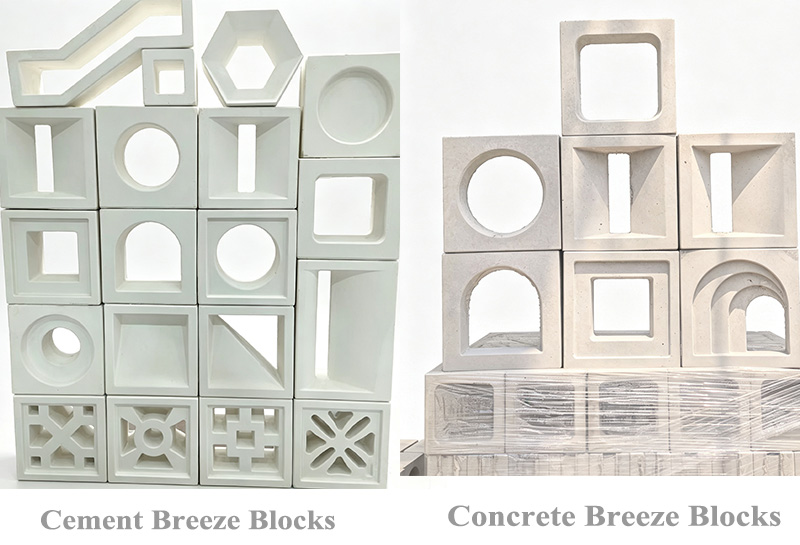
A Quick Warning on Terminology: Don't confuse either of these with a standard "structural concrete block (CMU)". Standard concrete blocks are dense, heavy, made with heavy gravel aggregates, and are meant to hold up foundations and load-bearing walls. Neither a patterned cement breeze block nor a lightweight concrete breeze block should ever be used to carry heavy structural building loads.
If you are buying these for a project, your choice should mostly come down to the "visual pattern" and the "texture" you prefer for your space. If you want a sleek, flawless look, seek out a smooth cement-sand mix. If you prefer a more rustic, classic mid-century look, a traditional concrete or cinder-aggregate block will serve you well.